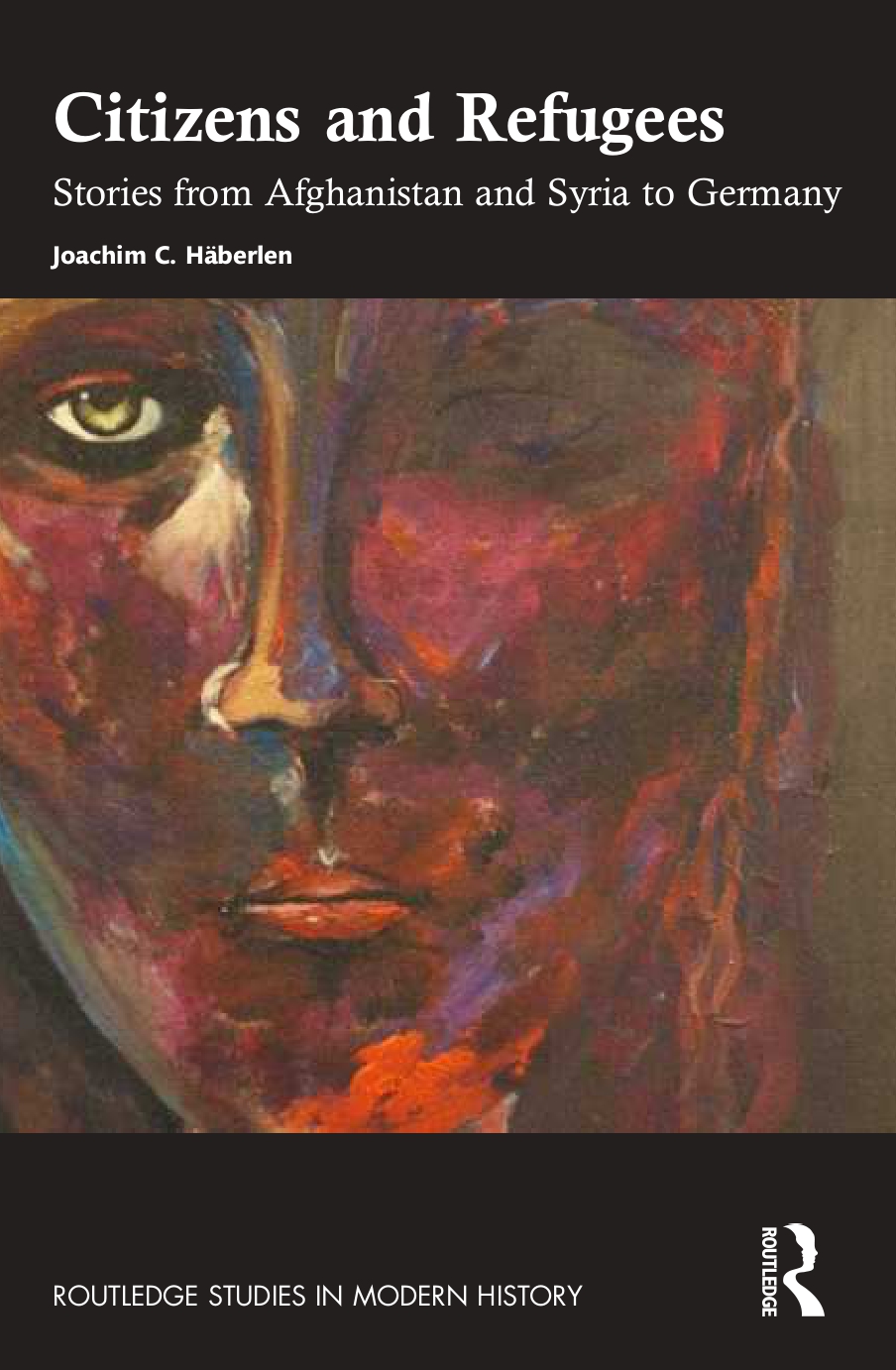
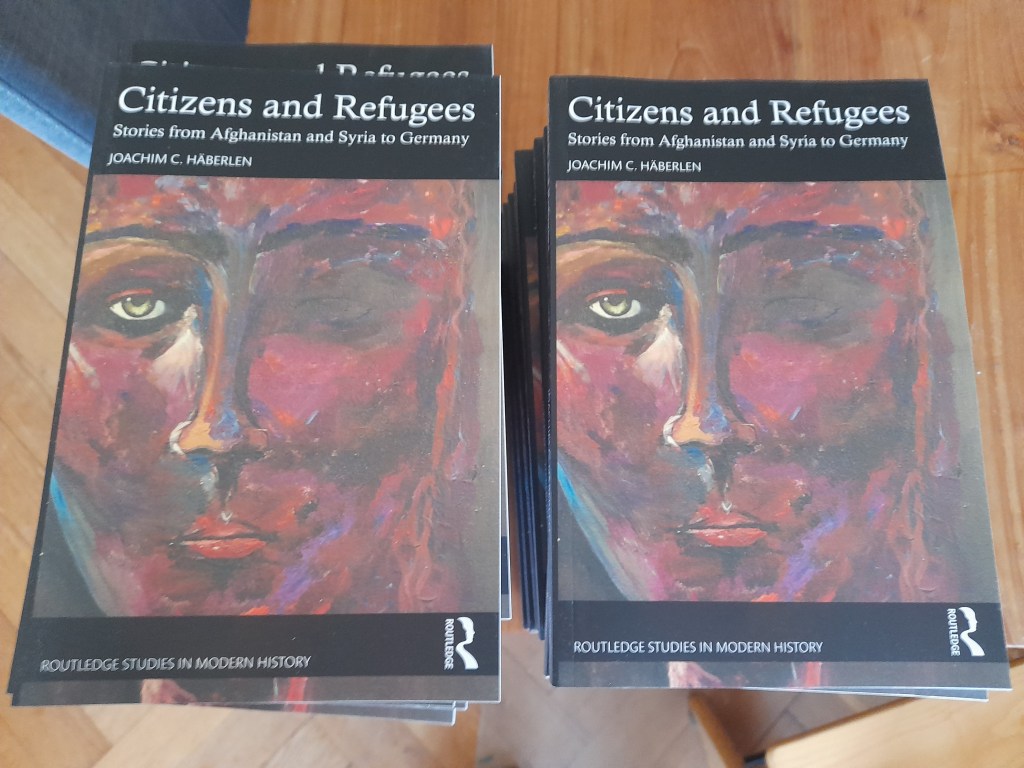
I’m immensely grateful for a very kind featured review of Citizens and Refugees: Stories from Afghanistan and Syria to Germany in Central European History by Christopher A. Molnar. The book, he writes, is “highly recommended to historians of modern Germany and scholars in a range of fields who work on migration and refugee studies. The accessible writing style also makes it suitable for advanced undergraduates.” I deeply appreciate these comments and recommendations, and of course hope that the book will be read in classes.
Molnar kindly quotes the final paragraph of my preface that also describes, roughly, how he felt about the book:
“This book, then, is certainly not a typical work of academic history, based on archival research and an intimate knowledge of a vast literature, but it is, emphatically, about history. At least I have learned something profound about history by listening to these stories, and not just about the history of the refugee crisis and what preceded it. For that, I’m immensely grateful.”
I want to use the opportunity of Molnar’s review to outline some the goals I hoped to accomplish with the book – what writing it and above all listening to the stories of its protagonists has taught me about history.
The conversations I had on which the book rests began with a seemingly trivial question: When does your story begin? It’s a question that frames the stories we tell. Posing this question to those who fled from Afghanistan and Syria to Germany yielded a range of answers that, collectively, challenge us – or at least challenged me – to rethink the framing of “the story.” They were not telling a history of the long summer of migration, even if that moment of 2015/16 functioned in a way as a nodal point. Their stories reached back much further, into the histories of Afghanistan and Syria; they deal with moments of hope – when US led forces ended the Taliban regime in Afghanistan, when Syrians started their revolution in 2011 – but also with bloody civil wars and bitter disappointments. Those are stories that happened outside the shores of Europe. They were not, at least not primarily, about the experience of fleeing and migrating; those were stories detailing difficult political struggles and courageous ways of acting as citizens in adverse circumstances. It’s indeed telling that Sabrina’s story with which the book opens and that inspired the entire project ends the very moment she became a refugee. Telling the stories of those who fled is then a plea against more histories of refugees and migration (even though “refugees” is part of the book’s title), against histories of the “long summer of migration,” and more generally for including the political histories of those who fled into our – and this is a very emphatic our – histories.
Writing the book also taught me something about the intimacy of history that is all too often lost, it seems to me, in scholarly accounts. The telling of history is not just our professional business, but what people do in countless everyday conversations. History has a profound personal meaning that is generated in such interactions. For me, this was a crucial lesson: we need to understand how history, as a narrative about the past, happens in a myriad of fractured ways when people talk to each other, and not just in whatever commemorative activities we usually investigate when thinking about forms of remembering. I don’t think history has ever been more meaningful, and a very personal level, than in those conversations over a cup of coffee or a glass of beer.
Most troubling and eye-opening were exactly those moments in which interlocutors did not say what I’d expect them to say, and I hope to have retold some of those moments. Molnar quotes one of them, when I shared a video of Syrian protestors with my friend Rahaf, and she responded: Do you know how many of the people singing in the video are dead by now? Of course, I didn’t; and I admit, there was nothing I had to say in response to her. I don’t think I had ever realized before how destructive violence can be; her comment shook me to the bones. (And I’m not sure I really convey that feeling in the book.) Listening to such stories was, for me, incredibly instructive.
Given my personal involvement in gathering these stories, as interlocutor rather than interviewer, there was no way of writing the book without weaving myself into the story, but, I hope, without making it all about myself. And as important a strong, argumentative voice is, I also hope to give readers a sense of how much I questioned myself and my assumptions in the process of producing the book. In that sense, the book was also an attempt to write history in a more, as it were, intimate way.
As always, if you’re interested in having me talk about the book to students or at a research colloquium, please don’t hesitate to reach out. I’d also be happy to arrange conversations with some of its protagonists!
 Joachim C. Häberlen, Ph.D.